
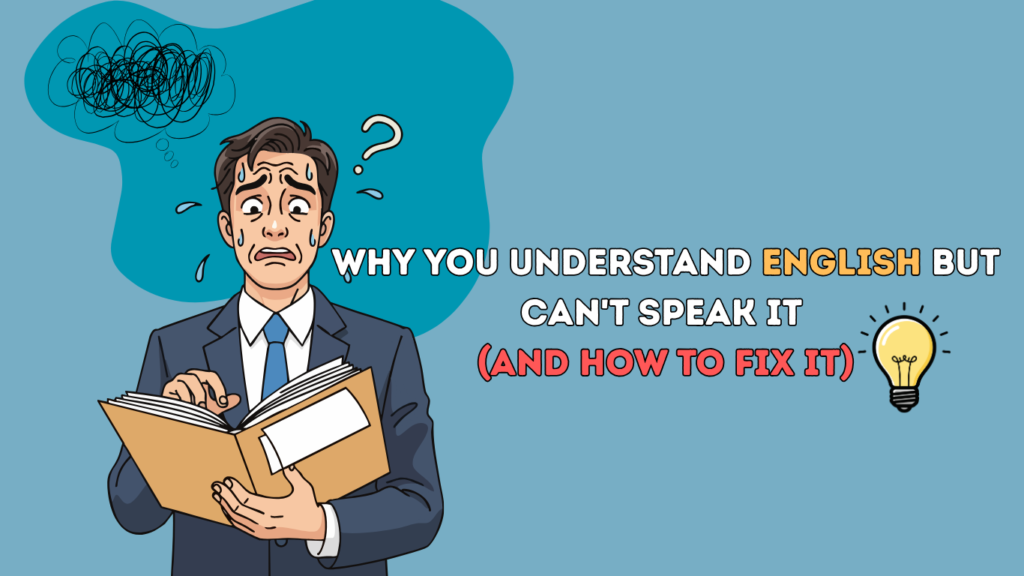
Here’s a million-dollar question: Why can you watch an English movie, read a whole paragraph, and nod along, but the second someone says “so, say it back to me,” your brain just… leaves the building?
Trust me! We have all been there. Every single one of us. If you’ve ever sat through an English class, understood every word the teacher said, and then frozen completely when it was your turn to speak English, welcome. You are not alone. In fact, you are in very, very good company.
There’s even a name for this phenomenon in linguistics: receptive vs. productive skills. Fancy words for a simple truth, understanding a language and actually speaking it are two completely different skills. You can be a brilliant football analyst sitting in the stands, knowing every rule of the game, and still trip over the ball the moment you step onto the field.
Why You Can Understand English But Still Can’t Speak It
Let me paint you a picture. One of my students came to me completely frustrated. She’d been studying English for six years. Six years! She could read a BBC article and understand it completely. She’d binge-watched two full seasons of a show in English. She knew her grammar rules better than most native speakers.
“I open my mouth, and it’s like my tongue forgets English ever existed. All the words are in my head. I can see them. But when I try to say them, my mouth freezes. Or something completely wrong comes out, and I just want to disappear.“
~Amara, after six years of English study
Sound familiar? Of course it does. Because this is not a you-problem. This is a training problem. All those years, Amara had trained one muscle: the reading-listening muscle. Nobody had asked her to train the speaking muscle. So it just… sat there. Perfectly capable, completely untrained.
As they say, “A sword unused grows rusty.” And your speaking ability? Let’s just say it’s been sitting in the drawer for a while.
“The tongue is like a lion; if you let it loose, it devours.”
~Arab Proverb ·
The reverse is also true: keep it caged, and it forgets how to roar.
Why You Freeze When Speaking English: The Real Reasons
Let’s be real. It’s not just about vocabulary or grammar. Here’s what’s really happening, and I want you to read this and nod along, because every single one of these will hit home.
1. You’re Translating in Your Head, and It’s Exhausting
You hear someone say “What do you think about this?” and before you can respond, your brain is already sprinting; translating the question into your mother tongue, forming an answer in your mother tongue, and then trying to reverse-translate it back into English in real time. By the time you’ve done all that, the conversation has moved on, and you’re sitting there with a perfectly crafted sentence and absolutely nowhere to put it.
You’re basically running Google Translate inside your head. In a thunderstorm. With bad WiFi. No wonder your mouth doesn’t cooperate.
Native speakers don’t think in sentences: they think in chunks, in phrases, in feelings that automatically come out as words. That automatic mode? That’s what we’re building toward. And it takes practice; you actually do it out loud, not just think about it.
2. Fear of Speaking English: The Great Silencer
Here’s one nobody talks about enough: fear of judgment is doing more damage to your English speaking than any grammar rule ever could.
Another student of mine; a brilliant guy, an engineer, would type in English at work all day long. Emails, reports, everything. But get him on a video call with an international client? His hands would shake. Not because he didn’t know English. Because he was terrified of making a mistake in front of people.
“What if I say the wrong word and they laugh? What if my accent is too thick? What if I sound stupid? It’s easier to just nod and stay quiet.”
~Raj, software engineer, four years of written English experience
And here’s what I told him, and I’ll tell you the same: everyone sounds a little different. Everyone has an accent. Every single person who speaks English as a second language has made more mistakes than they can count, and they kept going anyway. The people worth speaking to won’t laugh. And the people who laugh? They’re not worth speaking to.
Fluency is not about perfection. It’s about being understood. Even native speakers stumble, repeat themselves, and say “um” approximately ten thousand times a day. Give yourself the same grace.
3. The “I’ll Speak When I’m Ready” Trap
We’ve all said it. “I’ll start speaking once my vocabulary is better. Once I finish this grammar course. Once I feel more confident.” And then; months pass. The course ends. The confidence never quite arrives. And the speaking never begins.
Here’s the hard truth: you will never feel ready. You just have to begin.
It’s like waiting to jump into a swimming pool until you feel like a swimmer. You become a swimmer by being in the water, not by standing next to it analyzing the depth. The water is cold, yes. Your strokes are messy, yes. You splash everyone around you, yes. That is perfectly fine. That is how it works.
“The journey of a thousand miles begins with a single step.”
~Lao Tzu ·
And the journey to English fluency begins with a single (possibly awkward) sentence.
How to Actually Improve Your English Speaking: What Works
And no, I am not about to tell you to “watch movies, read books, and practice daily.” You’ve heard that a million times. We’re going deeper. Here’s what actually works:
1. You Cannot Speak English Fluently Until You Actually Open Your Mouth
I know, I know, sounds obvious. But let me say it louder for everyone in the back: all the passive learning in the world cannot replace real speaking time. You have to open your mouth. Even to yourself. Even badly. Especially badly. The only way out is through, and through means out loud.
Start today. Right now, if you want. Read this paragraph out loud. Seriously, do it. That’s one more minute of English speaking practice than most people will get today.
2. Find an English Speaking Partner: Yes, a Real Human
Platforms like iTalki, Tandem, and Speaky connect you with real people who want to practice English conversation, many of whom are in exactly the same boat as you. You’re not performing for an examiner. You’re just two people, figuring it out together. The pressure drops, the conversation flows, and before you know it, you’re speaking English.
And if you want something more structured, that’s exactly why PrepLingo was built. It’s not just another app. It’s a space where you work one-on-one with a real trainer who meets you where you are, practice in group sessions with fellow learners where nobody’s judging anyone because you’re all in the same boat, and learn through interactive games and guided conversations that make the whole thing feel less like homework and more like actually talking to people. Random practice helps, but guided practice genuinely changes things.
3. The Mirror Method: Your First Audience Is You
Stand in front of a mirror. Talk. About anything. About what you had for breakfast, what you think about the weather, what you plan to do this weekend. Watch your face while you speak. Notice your expressions, your mouth movements. It sounds strange, and yes, you will feel like a complete fool for the first three days but something shifts when you can see yourself speaking. You become more aware, more intentional, and slowly, more natural.
4. Daydream in English: You’re Already an Expert at This
We all do it. We all have little movies playing in our heads; arguments we’re planning, conversations we’re rehearsing, speeches we’ll never actually give. You know how you sometimes plan exactly what you’ll say in a confrontation while you’re washing dishes? Do that. In English. Narrate your life like a documentary. “Right, so I’m currently making tea. The kettle is rather aggressive today.” Those imaginary conversations are free, private, zero-pressure English speaking practice. Use them.
Bonus: next time you’re stuck in traffic, don’t just seethe quietly; give a running commentary on the situation in English. “The gentleman in the vehicle ahead of me appears to have forgotten that green means go.” Nobody can hear you. The stakes are zero. Go wild.
5. How to Stop Translating in Your Head: Think in Chunks
Instead of trying to translate whole sentences, learn phrases as complete units. “By the way,” “to be honest,” “if I’m not mistaken,” “that being said” these are chunks that native English speakers use automatically. When you learn them as one piece rather than building them word by word, they start to come out naturally. Your brain stops doing the translation in gym class and starts running on instinct.
6. Record Yourself: Then Have the Courage to Listen Back
Voice memos. That’s it. Record yourself speaking English for 60 seconds about anything. Play it back. I know: excruciating. Nobody enjoys hearing their own voice. But it tells you things that no teacher can: where you pause too much, where you rush, where you actually sound better than you thought. Do it once a week and compare. Progress, measured in your own voice, is deeply motivating.
7. Try the Shadowing Technique
This one is criminally underused. Find a short video or audio clip of someone speaking English naturally. Play it, then immediately repeat what they say, copying their rhythm, their tone, their pauses. You’re not just practicing words, you’re training your mouth to move the way English actually moves. Pronunciation, flow, intonation: all three at once, no grammar lesson required.
8. Create Tiny Immersion Moments Not a Full Lifestyle Overhaul
Change your phone’s language to English. Think out your grocery list in English. When you can’t remember a word: look it up immediately, say it out loud three times, use it in a sentence. These small moments compound. They don’t require a dramatic life change. They just require a little intention, sprinkled throughout the day you’re already living.
Stop waiting to speak until you’re fluent. Speaking is how you become fluent. They are the same thing. There is no “after I’m ready”, readiness is built in the speaking, not before it.
“A bird does not learn to fly by studying the wind. It learns by spreading its wings.”
~ Old Proverb ·
You know what to do with this one.
One Last Thing Before You Go
You are not broken. Your brain is not broken. Your English is not broken. You have simply been doing a lot of one thing, absorbing, and very little of another, producing. That’s an imbalance, and imbalances can be corrected.
The gap between understanding and speaking English is real, but it is not permanent. It closes every single time you open your mouth and try even clumsily, even quietly, even just to yourself in the car with the windows rolled up. Every. Single. Time.
So here is my challenge to you: before you close this page, say one sentence out loud in English. Just one. It can be about this article. It can be about your lunch. It can be “I don’t know what to say, but I am saying it anyway.” Whatever it is, say it out loud. That is your first step, and first steps, no matter how small, are how every single journey ever taken has begun.
“The expert in anything was once a beginner.”
~Helen Hayes ·
And every fluent English speaker was once exactly where you are right now.
Ready to Actually Start Speaking?
PrepLingo connects you with real trainers and a community of learners who are all in exactly the same place you are; willing to try, willing to make mistakes, and willing to get better together.